
Rapid response through the simple and quick method diagnosis,
minimizing the economic loss of customers.
LIVESTOCK ANIMALS


RIDX®
FMDV 3ABC Ab Test Kit
[LGM-VFB-73]
DESCRIPTION
Foot-and-mouth disease virus (FMDV) causes an acute systemic diseases of cloven-hoofed animals and continues to be threat to livestock worldwide with outbreaks causing severe economic losses. The RIDX® FMDV 3ABC Ab Test Kit is a lateral flow chromatographic immunoassay for the qualitative detection of antibodies to FMDV in bovine or porcine blood specimens. This kit shows two letters which are the test (T) line and the control (C) line on the surface of the device. If the FMDV antibodies exist in the samples, that bind to the cellulose nano beads-conjugated recombinant 3ABC non-structural protein (NSP) of FMDV. The antigen-antibody complexes move through the membrane by capillary force and respond to the Protein A on the test line, resulting in a blue line. The control line indicates that the test is performed correctly and should appear when the test is complete. The high-quality recombinant 3ABC non-structural polyprotein antigen of FMDV is used as a detector in the kit. As the 3ABC non-structural polyprotein is very conservative protein in all FMDV serotypes, the RIDX® FMDV 3ABC Ab Test Kit can detect FMDV antibodies to all seven serotypes of FMDV in bovine or porcine whole blood, serum, or plasma with high accuracy.
SPECIMEN
Whole blood, serum or plasma of ruminants
COMPONENTS
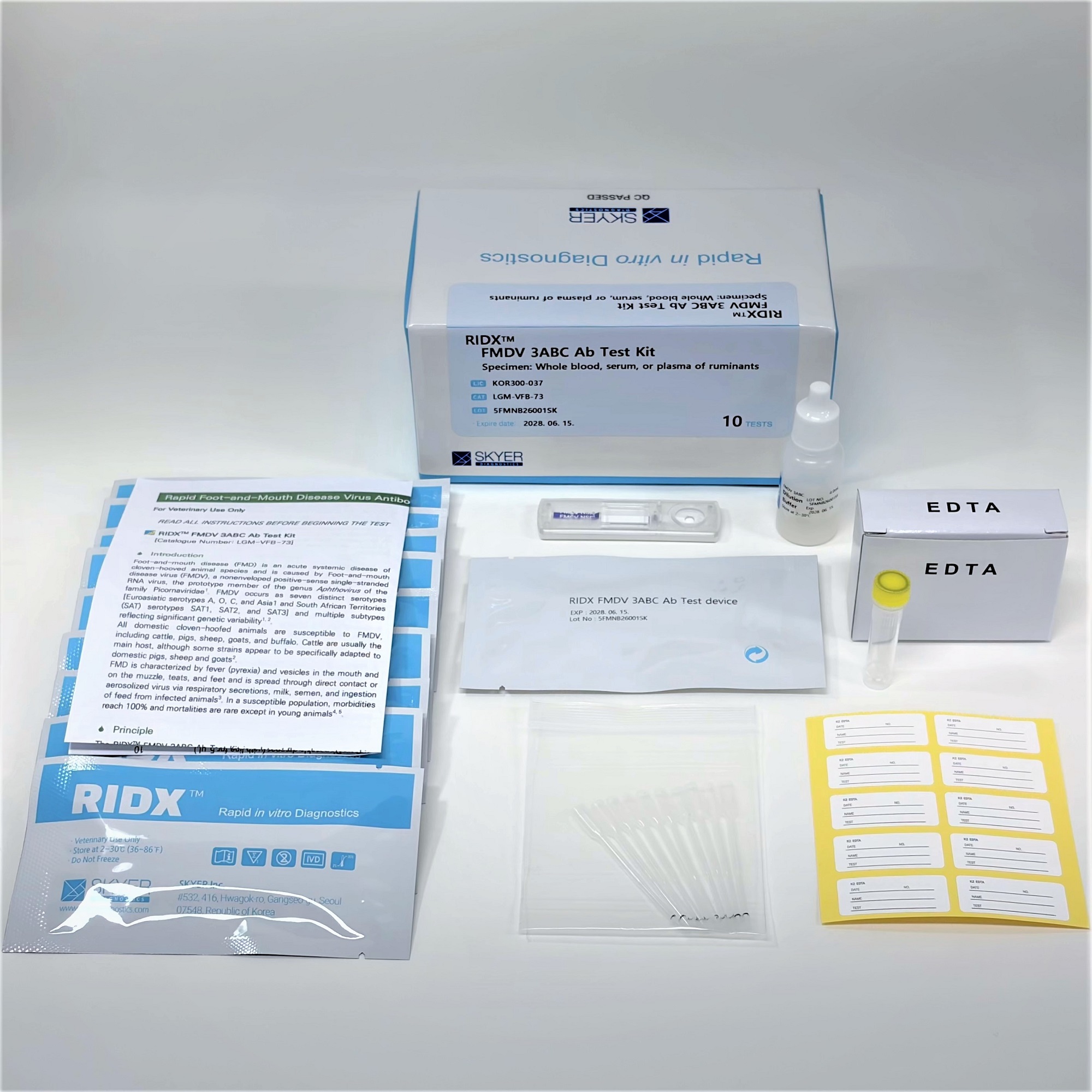
• RIDX FMDV NSP Ab test device (10 tests)
• Dilution buffer (1 vial)
• Disposable capillary tube (10 ea)
• Anticoagulant tube (with EDTA, 10 ea)
• Instructions for use (1 sheet)
FEATURES
• Sensitivity: Bovine 100% (30/30) vs. ELISA, Porcine 83.33% (25/30) vs. ELISA
• Specificity: Bovine 99.60% (498/500) vs. ELISA, Porcine 99.20% (496/500) vs. ELISA
• Diagnostic Agreement: Bovine 99.62% (528/530) vs. ELISA, Porcine 98.30% (521/530) vs. ELISA
• Limits of Detection (VNT titer): Type O 64, type A 5.5, type Asia1 177, type SAT2 512
PACKAGE
• 10 Tests/Kit [LGM-VFB-73]
TEST PROCEDURE
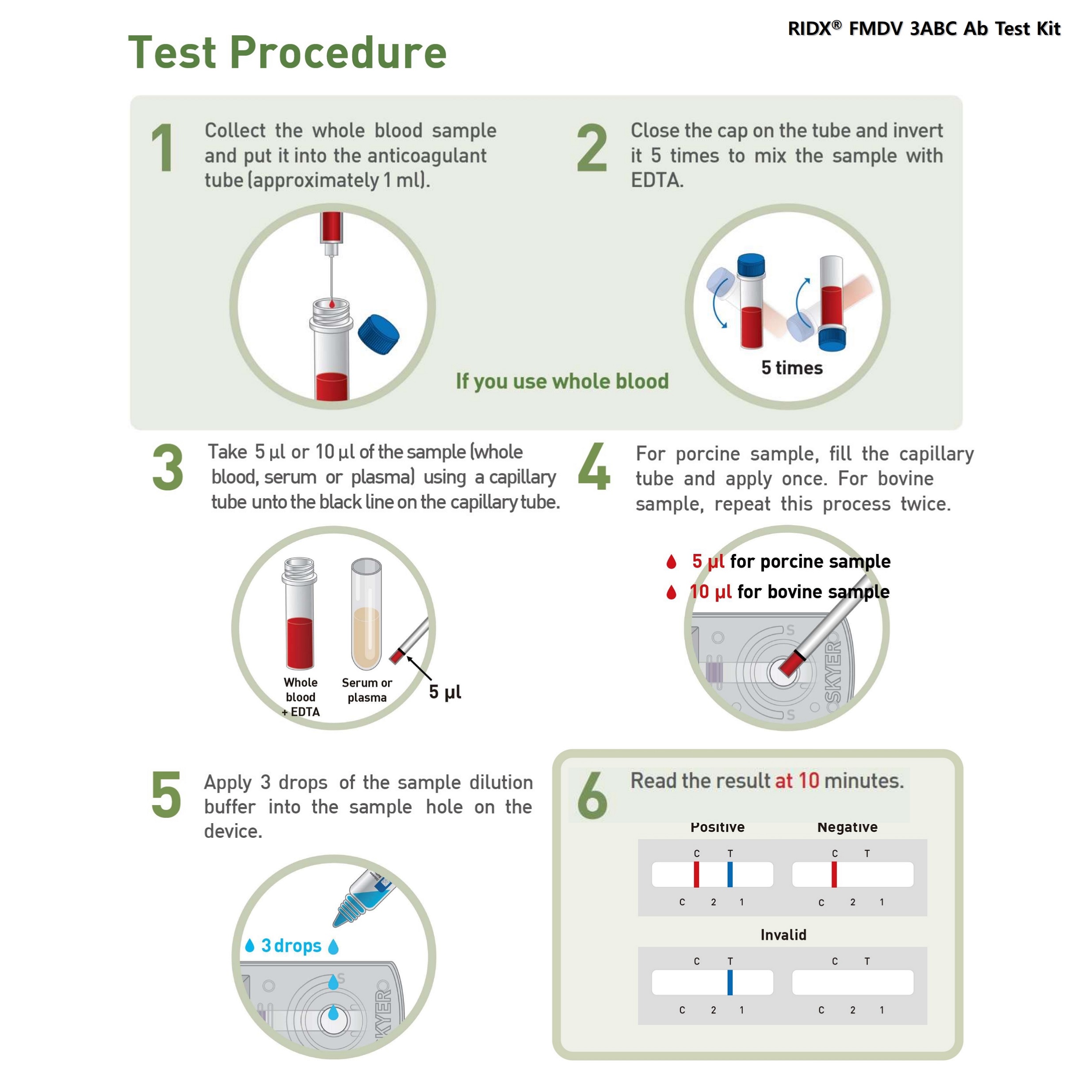
1. All samples and test components should be at room temperature (15~30°C/59~86℉) before use.
2. Using a capillary tube, take a specimen (anticoagulated whole blood, serum or plasma) and apply it to the sample hole (S). For porcine specimens, fill the capillary tube up to the 5 μL line and apply once; for bovine specimens, since 10 μL is required, repeat this process twice.
3. Apply 3 drops (approximately 100 μL) of dilution buffer into the sample hole (S).
4. Read test results at 10 minutes. Do not read results that appear after 10 minutes.